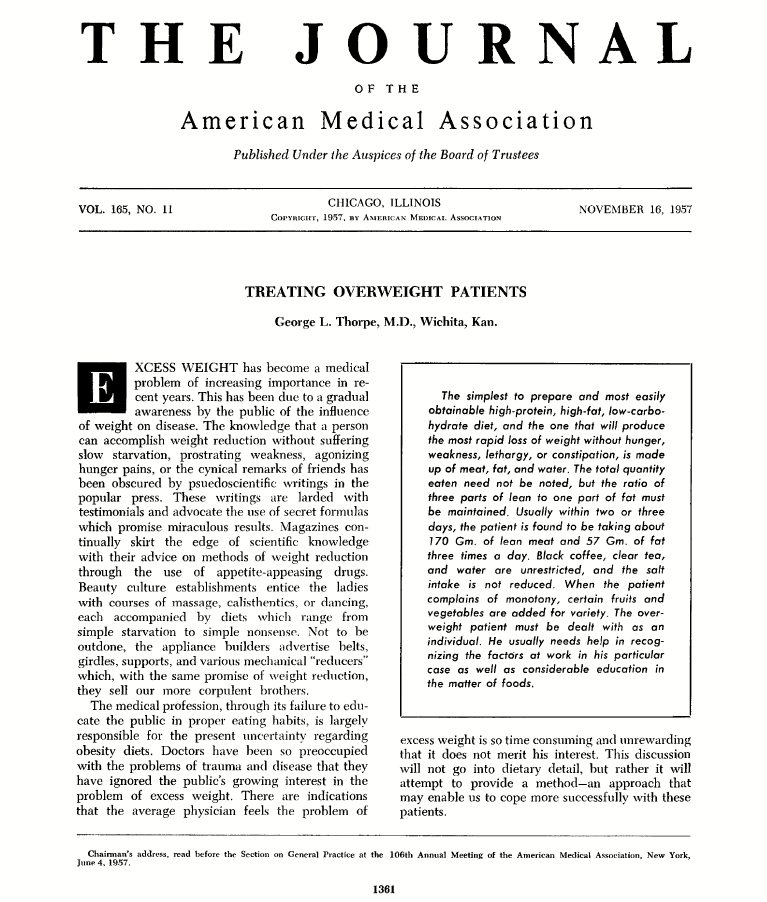
En 1957, le « Journal of the American Medical Association (JAMA) » publiait un article intitulé « Treating Overweight Patients« , rédigé par le Dr George L. Thorpe, médecin du Kansas. Dans ce texte issu d’un discours prononcé lors d’une réunion de l’American Medical Association, l’auteur critiquait les approches populaires de l’époque (régimes de restriction calorique, pilules, ceintures amaigrissantes, etc.) et proposait une méthode simple pour traiter l’excès de poids.
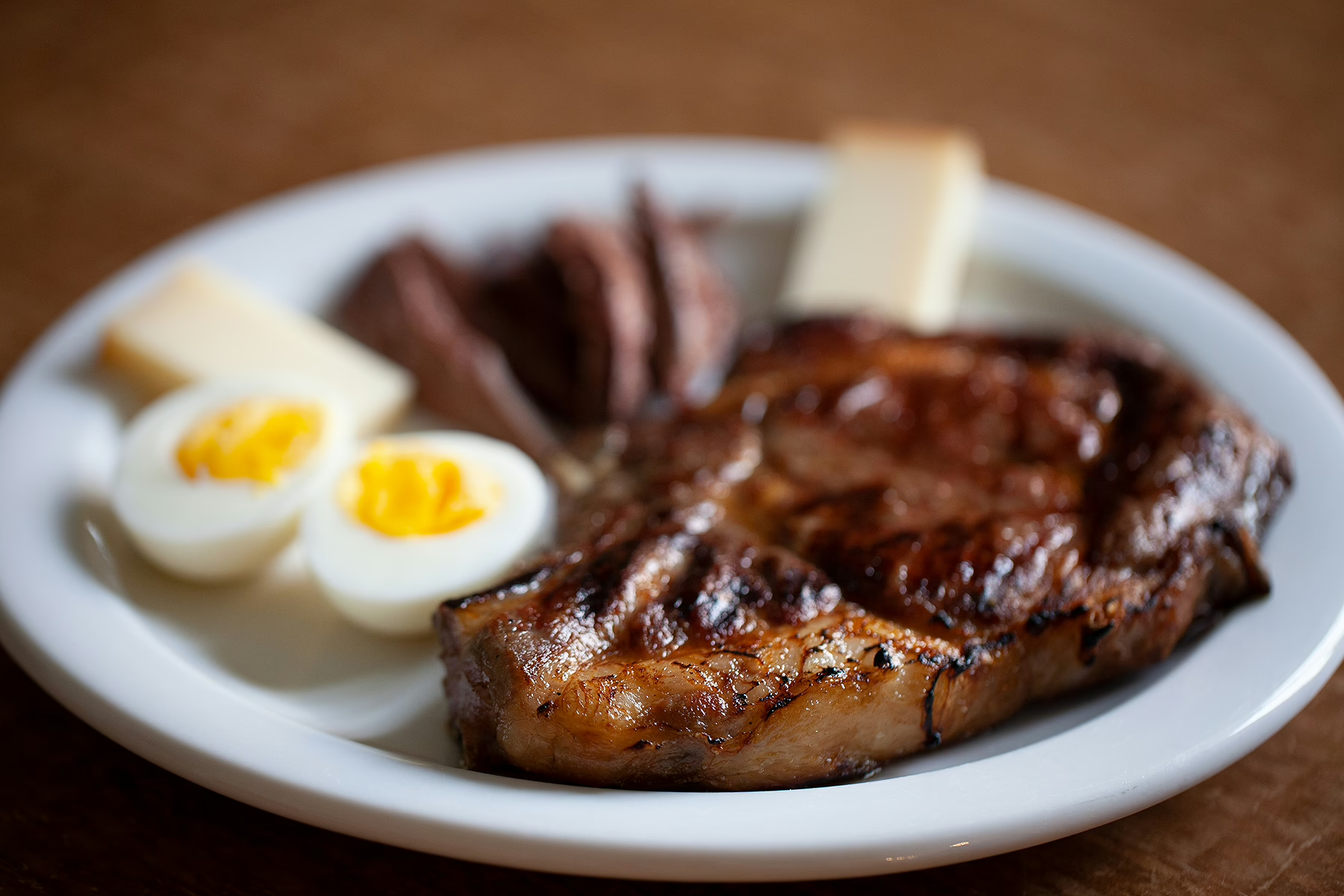
Le Dr Thorpe recommandait un régime hyperprotéiné, riche en gras et très pauvre en glucides. Un régime centré principalement sur la viande, le gras et l’eau, sans restriction calorique stricte, comme la façon la plus rapide et la plus tolérable de perdre du poids rapidement, sans faim, faiblesse, ni constipation.
Ce document montre que les principes d’une alimentation faible en glucides pour gérer l’obésité étaient déjà clairement articulés par la médecine officielle il y a plus de 65 ans.
Par contre, depuis les années 1960-1970, des recherches biaisées ont diabolisé les graisses saturées, la viande, les œufs et le beurre. Les directives officielles poussaient le régime faible en gras et riche en glucides.
Ce changement de cap a ouvert le chemin à l’explosion des produits ultratransformés générant des profits massifs pour l’industrie agroalimentaire et, plus tard, pour l’industrie pharmaceutique via les traitements du diabète, des maladies cardiovasculaires et de l’obésité. Des maladies qui, ironiquement, n’ont cessé d’augmenter depuis des décennies malgré ces recommandations.
Voici quelques extraits choisis de l’article du Dr George L. Thorpe publié dans le Journal of the American Medical Association (JAMA) en novembre 1957. Je te les présente en version originale anglaise, suivi d’une traduction libre en français.
Le régime le plus simple
The simplest to prepare and most easily obtainable high-protein, high-fat, low-carbohydrate diet, and the one that will produce the most rapid loss of weight without hunger, weakness, lethargy, or constipation, is made up of meat, fat, and water. The total quantity eaten need not be noted, but the ratio of three parts of lean to one part of fat must be maintained. Usually within two or three days, the patient is found to be taking about 170 Gm. of lean meat and 57 Gm. of fat three times a day. Black coffee, clear tea, and water are unrestricted, and the salt intake is not reduced. When the patient complains of monotony, certain fruits and vegetables are added for variety. The overweight patient must be dealt with as an individual. He usually needs help in recognizing the factors at work in his particular case as well as considerable education in the matter of foods.
Traduction en français
Le régime le plus simple à préparer et le plus facilement accessible, riche en protéines, riche en gras, très pauvre en glucides, et celui qui permet la perte de poids la plus rapide sans faim, sans faiblesse, sans léthargie ni constipation, est composé de viande, de gras et d’eau. Il n’est pas nécessaire de noter la quantité totale ingérée, mais le rapport de trois parties de viande maigre pour une partie de gras doit être maintenu. En général, au bout de deux ou trois jours, le patient consomme environ 170g de viande maigre et 57g de gras, trois fois par jour. Le café noir, le thé clair et l’eau sont autorisés sans restriction, et l’apport en sel n’est pas réduit. Lorsque le patient se plaint de monotonie, certains fruits et légumes sont ajoutés pour varier. Le patient en surpoids doit être traité en tant qu’individu. Il a généralement besoin d’aide pour identifier les facteurs spécifiques à son cas, ainsi qu’une éducation approfondie sur les aliments.
Critique des méthodes populaires
Magazines continually skirt the edge of scientific knowledge with their advice on methods of weight reduction through the use of appetite-appeasing drugs. Beauty culture establishments entice the ladies with courses of massage, calisthentics, or dancing, each accompanied by diets which range from simple starvation to simple nonsense. Not to be outdone, the appliance builders advertise belts, girdles, supports, and various mechanical « reducers » which, with the same promise of weight reduction, they sell our more corpulent brothers. The medical profession, through its failure to educate the public in proper eating habits, is largely responsible for the present uncertainty regarding obesity diets.
Traduction en français
Les magazines frôlent constamment les limites de la connaissance scientifique avec leurs conseils sur les méthodes d’amaigrissement fondées sur l’utilisation de médicaments coupe-faim. Les instituts de beauté attirent les dames avec des cures de massage, de gymnastique callisthénique ou de danse, chacune assortie de régimes allant de la simple famine au pur non-sens. Pour ne pas être en reste, les fabricants d’appareils publicisent des ceintures, gaines, soutiens et divers « réducteurs » mécaniques qu’ils vendent, avec la même promesse d’amincissement, à nos frères plus corpulents. La profession médicale, par son échec à éduquer le public sur de saines habitudes alimentaires, est en grande partie responsable de l’incertitude actuelle concernant les régimes contre l’obésité.
Les médecins évitent le sujet
There are indications that the average physician feels the problem of excess weight is so time consuming and unrewarding that it does not merit his interest.
Traduction en français
Certains signes indiquent que le médecin moyen juge le problème du surpoids si laborieux et si peu rémunérateur qu’il ne mérite pas qu’il s’y attarde.
Moins de glucides, moins d’insuline
Restriction of carbohydrate intake removes the stimulus to insulin production, so that the fat storage activity of insulin will be held to a minimum.
Traduction en français
La restriction des glucides supprime le stimulus à la production d’insuline, de sorte que l’activité de stockage des graisses exercée par l’insuline est réduite au minimum.
La mobilisation des graisses domine
The anterior pituitary fat-mobilizing principle will then predominate over the fat-storing forces. Fat will be mobilized from the adipose deposits of the body, oxidized to ketones in the liver, and circulated to the tissues in this easily combustible form.
Traduction en français
Le principe de mobilisation des graisses sécrété par l’hypophyse antérieure prendra alors le dessus sur les forces de stockage des graisses. Les graisses seront mobilisées depuis les dépôts adipeux du corps, oxydées en corps cétoniques dans le foie, puis transportées vers les tissus sous cette forme facilement combustible.
Observation du régime esquimau
According to Pennington, Dr. Vilhjalmur Stefansson, anthropologist and arctic explorer, observed that Eskimos were never obese when following their accustomed diet of lean and fat meat but that obesity appeared among them with great rapidity when concentrated carbohydrate foods were introduced.
Traduction en français
Selon Pennington, le Dr Vilhjalmur Stefansson, anthropologue et explorateur de l’Arctique, a observé que les Esquimaux n’étaient jamais obèses lorsqu’ils suivaient leur régime habituel composé de viande maigre et de gras, mais que l’obésité apparaissait chez eux avec une grande rapidité dès l’introduction d’aliments concentrés en glucides.
Le gras brûle plus de calories
During calorimetric tests at the Bussell Sage Institute in 1928, a man lost excess weight while eating a diet of lein and fat meat with a calorie value of 2,000 to 3,000 calories daily. As 80% of the calories in this diet were derived from fat, it was apparent that his body was able to burn more food on this diet than on an ordinary mixed diet.
Traduction en français
Lors de tests calorimétriques réalisés à l’Institut Russell Sage en 1928, un homme a perdu de l’excès de poids en suivant un régime composé de viande maigre et de gras, apportant entre 2000 et 3000 calories par jour. Comme 80% des calories de ce régime provenaient des graisses, il était évident que son corps était capable de brûler davantage de nourriture sur ce régime que sur un régime mixte ordinaire.
Les graisses et protéines font maigrir
Kekwick and Pawan recently reported significant loss of weight on a calorie intake of 2,600 per day, provided this intake was given mainly in the form of fat and protein. These observations, when considered together, would support the idea that a high-fat, high-protein, low-carbohydrate diet should be beneficial, regardless of which mechanism was considered to be the cause of the excess weight-excessive carbohydrate intake or faulty carbohydrate metabolism.
Traduction en français
Kekwick et Pawan ont récemment rapporté une perte de poids significative avec un apport calorique de 2600 calories par jour, à condition que cet apport provienne principalement des graisses et des protéines. Ces observations, considérées ensemble, appuient l’idée qu’un régime riche en graisses, riche en protéines et pauvre en glucides devrait être bénéfique, quel que soit le mécanisme considéré comme cause de l’excès de poids, qu’il s’agisse d’un apport excessif en glucides ou d’un métabolisme défectueux des glucides.
La médecine rapide échoue
The sure way to be unsuccessful is to have your nurse weigh the patient, then do a rapid physical examination, dash off a prescription for the newest combination of drugs, hand out a printed diet sheet, and say, « Come back in a month and let’s see how much weight you have lost.
Traduction en français
La façon la plus sûre d’échouer est de laisser votre infirmière peser le patient, de procéder à un examen physique rapide, de rédiger une ordonnance pour la dernière combinaison de médicaments à la mode, de remettre une feuille de régime imprimée, puis de dire : “Revenez dans un mois, on verra combien de poids vous avez perdu ».
Retour à une alimentation naturelle
Natural Diets – Proper eating is the natural and complete answer to the problem of excess weight. The words diet and dieting should be avoided. To the patient with excess weight, these words have acquired a meaning associated with a miserable, frustrating experience, ending in failure to reach even the most modest goal of weight reduction. This is especially true with patients who have had previous experience with total reduction of food or low-calorie diets in which starvation was obtained by counting calories.
Traduction en français
Les régimes naturels – Une alimentation appropriée constitue la réponse naturelle et complète au problème de l’excès de poids. Il faut éviter les mots “régime” et “faire un régime”. Pour le patient en surpoids, ces termes ont pris une connotation associée à une expérience misérable et frustrante, qui se termine invariablement par l’échec à atteindre même l’objectif le plus modeste de perte de poids. Cela est particulièrement vrai pour les patients ayant déjà vécu des expériences de restriction alimentaire totale ou de régimes hypocaloriques où la faim était obtenue par le simple comptage des calories.
La famine provoque la reprise
Starvation is accompanied by weakness, loss of energy, lethargy, constipation, and other unpleasant side-reactions, and, when the starvation diet is discontinued, the excess weight is regained. Second, starvation makes no effort to correct the original cause of excess weight. Therefore any success obtained must be maintained by chronic undernourishment, with the attendant long-range disastrous consequences common in malnutrition.
Traduction en français
La famine s’accompagne de faiblesse, de perte d’énergie, de léthargie, de constipation et d’autres réactions secondaires désagréables. Dès que le régime de famine est arrêté, l’excès de poids revient. Deuxièmement, la famine ne fait aucun effort pour corriger la cause originelle du surpoids. Par conséquent, tout succès obtenu doit être maintenu par une sous-nutrition chronique, avec toutes les conséquences désastreuses à long terme typiques de la malnutrition.
Les régimes hypocaloriques échouent
That the usual low-calorie diet is rarely successful is readily understood in the light of our present knowledge of carbohydrate and fat metabolism. A
low-calorie, low-fat diet is usually unsuccessful due to the ease with which the carbohydrate present is converted into fat by the body coupled with the fact that the presence of carbohydrate suppresses the fat-mobilizing ability of the pituitary gland and increases the fat-depositing activity of insulin.
Traduction en français
Que le régime hypocalorique classique soit rarement couronné de succès s’explique aisément à la lumière de nos connaissances actuelles sur le métabolisme des glucides et des graisses. Un régime pauvre en calories et pauvre en graisses échoue généralement pour deux raisons: d’une part, les glucides présents sont facilement convertis en graisses par l’organisme. D’autre part, la présence de glucides supprime la capacité de mobilisation des graisses de l’hypophyse et augmente l’activité de stockage des graisses exercée par l’insuline.
La clé: manger normalement, riche en protéines, riche en graisses
True, there are many small items that enhance the speed of weight loss, but the key to long-term success is the simple return to normal eating habits. Normal eating habits might be described in technical language as adhering to a high-protein, high-fat, low-carbohydrate diet.
Traduction en français
Certes, il existe de nombreux petits ajustements qui accélèrent la perte de poids, mais la clé du succès à long terme réside dans le simple retour à des habitudes alimentaires normales. Ces habitudes alimentaires normales peuvent être décrites en termes techniques comme le respect d’un régime riche en protéines, riche en graisses et pauvre en glucides.
Viande, gras et eau
The simplest to prepare and most easily obtainable high-protein, high-fat, low-carbohydrate diet and the one that will produce the most rapid loss of weight without hunger, weakness, lethargy, or constipation is made up of meat, fat, and water.
Traduction en français
Le régime le plus simple à préparer et le plus facilement accessible, riche en protéines, riche en graisses, très pauvre en glucides, et celui qui permet la perte de poids la plus rapide sans faim, sans faiblesse, sans léthargie ni constipation, est composé de viande, de gras et d’eau.
Le ratio 3:1 est essentiel
The total quantity eaten is not important, but the ratio of three parts of lean to one part fat must be maintained, as any decrease in the fat portion will reduce the weight loss. Few people can consume 12 oz. of lean meat and 4 oz. of fat three times a day. Usually, within two or three days, the average will be about 6 oz. lean meat and 2 oz. fat three times daily. I have yet to find a patient on this diet who complained of not having enough to eat, of tiredness, weakness, or constipation.
Traduction en français
La quantité totale consommée n’a pas d’importance, mais le rapport de trois parties de viande maigre pour une partie de gras doit être respecté: toute diminution de la proportion de gras réduira la perte de poids. Peu de personnes peuvent consommer 340g de viande maigre et 113g de gras trois fois par jour. En général, au bout de deux ou trois jours, la moyenne se situe autour de 170g de viande maigre et 57g de gras, trois fois par jour. Je n’ai encore jamais rencontré un patient suivant ce régime qui se soit plaint de ne pas avoir assez à manger, de fatigue, de faiblesse ou de constipation.
Notes: les équivalences en grammes de 12oz ≈ 340g et 4oz ≈ 113g sont approximatives et arrondies.
Ci-dessous, je te présente des idées de repas utilisant des valeurs approximatives pour la viande cuite et des valeurs standards pour les gras ajoutés. Les chiffres exacts peuvent varier légèrement selon la coupe et le mode de cuisson.
Les idées des tableaux suivants respectent le ratio de 3 pour 1 mentionné ci-dessus. Peux-tu t’imaginer manger trois de ces repas tous les jours?
Exemples à 12oz de viande + 4oz de gras (note: les valeurs des macronutriments et des calories sont approximatives)
| Viande + source de gras | Qté de viande (oz) | Qté de viande (g) | Qté de gras (oz) | Qté de gras (g) | Protéines de la viande (g) | Lipides de la viande (g) | Lipides de la source de gras (g) | Calories totales |
| Filet de bœuf + beurre | 12 | 340 | 4 | 113 | 104 | 31 | 92 | 1522 |
| Saumon sauvage + suif de bœuf | 12 | 340 | 4 | 113 | 87 | 28 | 113 | 1621 |
| Poitrine de poulet + beurre | 12 | 340 | 4 | 113 | 105 | 15 | 92 | 1382 |
| Poitrine de dinde + suif d’agneau | 12 | 340 | 4 | 113 | 102 | 7 | 113 | 1492 |
| Filet de porc + gras de canard | 12 | 340 | 4 | 113 | 96 | 19 | 113 | 1576 |
| Surlonge de bison + ghee | 12 | 340 | 4 | 113 | 95 | 8 | 113 | 1476 |
| Longe de morue + suif de bœuf | 12 | 340 | 4 | 113 | 78 | 3 | 113 | 1364 |
Les mêmes exemples à 6oz de viande + 2oz de gras (note: les valeurs des macronutriments et des calories sont approximatives)
| Viande + source de gras | Qté de viande (oz) | Qté de viande (g) | Qté de gras (oz) | Qté de gras (g) | Protéines de la viande (g) | Lipides de la viande (g) | Lipides de la source de gras (g) | Calories totales |
| Filet de bœuf + beurre | 6 | 170 | 2 | 57 | 52 | 16 | 46 | 761 |
| Saumon + suif de bœuf | 6 | 170 | 2 | 57 | 44 | 14 | 57 | 810 |
| Poitrine de poulet + beurre | 6 | 170 | 2 | 57 | 53 | 8 | 46 | 691 |
| Poitrine de dinde + suif d’agneau | 6 | 170 | 2 | 57 | 51 | 4 | 57 | 746 |
| Filet de porc + gras de canard | 6 | 170 | 2 | 57 | 48 | 10 | 57 | 788 |
| Surlonge de bison + ghee | 6 | 170 | 2 | 57 | 48 | 4 | 57 | 738 |
| Longe de morue + suif de bœuf | 6 | 170 | 2 | 57 | 39 | 2 | 57 | 682 |
Éduquer plutôt que prescrire
Rather than list the details of the composition of food, I endeavor to show the principle by which successful weight reduction can be obtained and weight maintained. This is a matter of education of ourselves as well as the overweight patient to cultivate more natural eating habits which, if followed, will correct the basic cause of overweight without the intolerable suffering of restrictive starvation-type diets.
Traduction en français
Plutôt que de détailler la composition des aliments, je m’efforce de montrer le principe qui permet d’obtenir une perte de poids réussie et de maintenir ce poids par la suite. Il s’agit d’éduquer à la fois nous-mêmes et le patient en surpoids afin de cultiver des habitudes alimentaires plus naturelles qui, si elles sont suivies, corrigeront la cause profonde de l’excès de poids sans les souffrances intolérables des régimes restrictifs de type famine.
Retour à une alimentation naturelle
Summary – The patient with excess weight not caused by disease must be dealt with as an individual whose excess weight may be due to excessive carbohydrate intake or a disturbance in his carbohydrate metabolism. Evidence from widely different sources, when examined in light of recent metabolism studies, seems to justify the use of high-protein, high-fat, low-carbohydrate diets for successful loss of excess weight. There are apparent defects in the rationale of the commonly used low-calorie restrictive diets, and there should be a return to a more natural type of diet. Drugs may be used, but their defects should be considered. Common foods such as cereals and milk are excellent, but, in my way of thinking, they have no place in the diet of the overweight individual.
Traduction en français
Conclusion – Le patient présentant un excès de poids non dû à une maladie doit être traité comme un individu dont la surcharge pondérale peut provenir d’un apport excessif en glucides ou d’un trouble du métabolisme des glucides. Les preuves issues de sources très diverses, lorsqu’elles sont examinées à la lumière des études récentes sur le métabolisme, semblent justifier l’utilisation de régimes riches en protéines, riches en graisses et pauvres en glucides pour obtenir une perte réussie de l’excès de poids. Il existe des défauts apparents dans la logique des régimes restrictifs hypocaloriques couramment utilisés, et il conviendrait de revenir à un type d’alimentation plus naturel. Les médicaments peuvent être employés, mais leurs inconvénients doivent être pris en compte. Des aliments courants comme les céréales et le lait sont excellents, mais, selon ma façon de penser, ils n’ont pas leur place dans le régime de l’individu en surpoids.
Recherches et références
[1] Barach JH. Obesity, Its Associated Diseases and Treatment. Am J Dig Dis. 1952 Feb;19:37-44. doi:10.1007/BF02876293. https://doi.org/10.1007/BF02876293
…by a return to normal body weight, they will delay or prevent the onset of chronic cardiovascular disease such as hypertension and arteriosclerosis in its various forms; certain diseases of the liver and gall bladder, perhaps arthritis, and above all diabetes; and, with these out of the way, they may then look forward to years of more endurable living in the second half of life.
I tell my fat ones that the gates of Heaven are narrow and those who would enter must conform to size.
[2] Armstrong DB, Dublin LI, Wheatley GM, Marks HH. Obesity and Its Relation to Health and Disease. JAMA. 1951 Nov 10;147(11):1007-1014. doi:10.1001/jama.1951.03670280009003.https://doi.org/10.1001/jama.1951.03670280009003
Not only can obesity become a physical impediment in itself, but it may predispose its victims to heart disease, diabetes, liver disease, and other complications.
[3] Barr DP. Health and Obesity. N Engl J Med. 1953 Jun 4;248(23):967-970. doi:10.1056/NEJM195306042482303. PMID: 13046656.https://doi.org/10.1056/NEJM195306042482303
It is not difficult to demonstrate that obesity is both disadvantageous and dangerous. A mere list of its hazards, disabilities and discomforts is formidable. Obesity predisposes to diabetes, increases che tendency to . . .
[4] Dublin LI. Relation of Obesity to Longevity. N Engl J Med. 1953 Jun 4;248(23):971-974. doi:10.1056/NEJM195306042482304. PMID: 13046657.https://doi.org/10.1056/NEJM195306042482304
Over the years vast changes have taken place in the daily life of people, and the eating habits that were formerly suitable for farmers, factory workers and housewives who had to do a great deal of manual labor are no longer suitable in the highly mechanized America of 1952. The pleasures of eating, however, are just as real today as they ever were, and there is no lack . . .
[5] Newburgh LH. Obesity. Arch Intern Med (Chic). 1942 Dec;70(6):1033-1096. doi:10.1001/archinte.1942.00200240117009.https://doi.org/10.1001/archinte.1942.00200240117009
Obesity is that condition in which the body contains an abnormally large amount of adipose tissue.
Since the accumulation of adipose tissue causes a corresponding increase in weight, much effort has been directed toward establishing a weight which is best in regard to longevity and mental and physical fitness.
[6] Bruch H. Psychological Aspects of Reducing. Psychosom Med. 1952 Sep-Oct;14(5):337-346. doi:10.1097/00006842-195209000-00001. PMID: 12993941.https://doi.org/10.1097/00006842-195209000-00001
The first point to be considered is that overweight people do not represent a homogeneous group.
The word ‘overweight,’ as it is commonly used, indicates nothing more than a statistical term, referring to a deviation from the arithmetical mean, often called the ‘ideal weight.’
[7] Brosin HW. The Psychology of Overeating. N Engl J Med. 1953 Jun 4;248(23):974-975. doi:10.1056/NEJM195306042482305. PMID: 13046658.https://doi.org/10.1056/NEJM195306042482305
As intensive medical experience provides more evidence that most obese patients suffer from emotional conflicts that can be described and altered, physicians will be able to treat them with greater confidence and success
[8] Gurin S. Lipogenesis. N Engl J Med. 1953 Jun 4;248(23):965-967. doi:10.1056/NEJM195306042482302.https://doi.org/10.1056/NEJM195306042482302
IN the field of lipid synthesis, knowledge is still scanty and rudimentary. Although the conversion of carbohydrate to fat by the living organism has been known to biologists for years, the intervening metabolic steps involved are almost completely unknown.
[9] Pennington AW. A Reorientation on Obesity. N Engl J Med. 1953 Jun 4;248(23):959-964. doi:10.1056/NEJM195306042482301. PMID: 13046654.https://doi.org/10.1056/NEJM195306042482301
DURING the past half-century, investigation of the problem of obesity has followed two distinct lines: that of the intermediary metabolism and that of the energy exchange. It would be natural to expect that the two types should merge and support each other in a unified concept of obesity, for, if a defect in the intermediary metabolism causes ingested food to be diverted to storage as excess fat, the total energy exchange should reflect this abnormality. Actually, however, two schools of thought have arisen and contended through the years, and it has only recently become possible to reconcile them.
[10] Pennington AW. Pathophysiology of Obesity. Am J Dig Dis. 1954 Mar;21:69-73. doi:10.1007/BF02880977.https://doi.org/10.1007/BF02880977
Limitation of dietary carbohydrate, specifically, as the chief source of pyruvic acid, makes possible a treatment of obesity without restriction of the total caloric intake.
[11] Pennington AW. Treatment of Obesity: Developments of the Past 150 Years. Am J Dig Dis. 1954 Mar;21:65-69. doi:10.1007/BF02880976.https://doi.org/10.1007/BF02880976
The history of obesity since the end of the 18th century is reviewed, with particular attention to events connected with the Banting dietary. This treatment appears to have been, originally, one in which carbohydrates were restricted but the total food intake was not restricted. Lacking a rationale, it became modified to. fit current concepts; it underwent transformation into a low calorie diet in which fat was greatly restricted.
Another, more recent, diet in which carbohydrate is restricted while the total caloric intake is not restricted is presented. The rationale for this treatment is indicated.

Laisser un commentaire